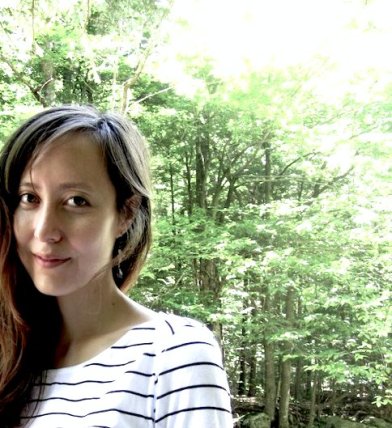
This week we chat with writer Mari Christmas, who will be doing a reading at Portneuf Valley Brewery, Thursday, October 18, at 5:00pm. We hope you can join us!
- How did you get your start in writing?
MC (Mari Christmas): Through a lot of false starts. The first was in high school, after reading Kurt Vonnegut – even now I think it’s impossible to read him without thinking he’s having a lot of fun. I had struggled with writing for so much of my early education (I failed every state-mandated writing test to the point where I had to sit in a special classroom writing five-paragraph essays on my favorite day of the week, and other horrible mind-numbing, deviant-building stuff). I wrote my first short story soon after that, using what I learned from reading Vonnegut. Then, my mother, even without reading my story or telling me, sent the piece off to the National Young Arts Foundation (they were having a short story contest for high school students – and my mother wanted desperately for me to go to college but didn’t think anyone would take me). It was a draft, and it received honorable mention! I think we were both equally surprised, especially when they sent me money. After that, I quit, totally, until I was halfway through undergrad. By that point I had built up all this internal pressure inside myself, and it was too overwhelming. It took me another five years to get over that.
- What influences your writing? Specific writers? Environment? Current events?
MC: Everything. I’m always listening for and seeking material. It’s a good way to be in the world, always listening, mining for another vein. Sometimes I listen to story podcasts or to lots of older novels using Librivox. I get into moods. I do a lot of walking around. I surround myself with books that I want a particular story to sound like – just to get that voice in my head. I’m drawn to writers who talk frankly, who write clean, strange sentences (Grace Paley, Etgar Keret, Nick Flynn, Jerzy Kosinski, J. D. Salinger, etc.). Not to mention, a lot of my personal anxieties play out while I write. Tom Waits talks about following the sound of the sound, but I wonder if I am, instead, chasing a feeling down, trying to get my hands on it so I can turn it over and really look at it.
- Do you find that there are recurring themes or questions that your work explores?
MC: I’m interested in the end of things (death, marriages, relationships) – like really, what happens afterwards? How do we go on? We always seem to. Overall, I work in two modes, one more serious than the other. It’s been a good balance, and I need both – the light and the dark. At the moment I feel I am in some sort of transition-period in my writing. I don’t know what it means yet.
- Is it difficult to wear both the editor and writer hats?
MC: Editing (whether for an issue or through teaching) other writers has served me well – and as a result I’m particularly brutal with my own edits and appreciative of receiving criticism from other editors. It’s about shaping material rather than saying that a sentence was “bad” or “good” or fixing grammar. If a section or sentence is not serving the rest of the narrative, it can and should go. End stop. Everything should be in service of the voice, the story – and usually I am at the point where I am desperate for feedback because I’m at the end of my own rope. So yes, editing has helped me get to that place where I’m absolutely looking for fresh horses, and by the time I ask a friend or colleague for comments, I’m totally on-board and grateful and willing to try whatever might get a story back on the trail. I also really trust a good reader and editor. They honestly have better things to do, so if they reach out, I really listen.
- What is some of the best writing advice you have been given?
MC: It’s more an exercise – one that I was taught early in my MFA by the amazing Valerie Sayers at the University of Notre Dame. I didn’t think it had such a profound effect on me until I noticed I wrote much better after having done this for a full semester. I use this in all my classes. It’s so simple and easy: basically, every time you read a book/story/whatever, you must write down the sentences that you love or find technically helpful. I’ve done this for years now, and when I can’t think, I go back and use them as templates.
- What are some of your favorite literary journals?
MC: I’m a huge fan of Joyland, Fence, The Literary Review (TLR), n+1, Cosmonauts Avenue, and, of course, the Paris Review. While I read a lot of established journals, newer journals take more risks so I love reading what they have to offer. I also love to look at the winning entries for contests judged specifically by writers I admire. Most journals hand those stories out for free online.
- Outside of writing, what are some of your hobbies?
MC: I draw. I love making and touching things with my hands, and I really want to get into woodworking. Last winter I started cross-country skiing. I need solitude to hear myself think. I like the winter, it feels like a hobby – liking winter – especially if you were raised in the south.
- What would people be surprised to learn about you?
MC: I don’t play board games.
- If you could have dinner or drinks with anyone in the world—dead or alive—who would it be and why?
MC: Hands down, I would love to meet a dead Grace Paley. I bet she would offer a good perspective of the after life.
- Finally, can you tell us about any projects we can expect to see from you in the future?
MC: I’m currently rewriting a book draft. Let’s hope it’s that.

 ISU's student Journal of Creative Works