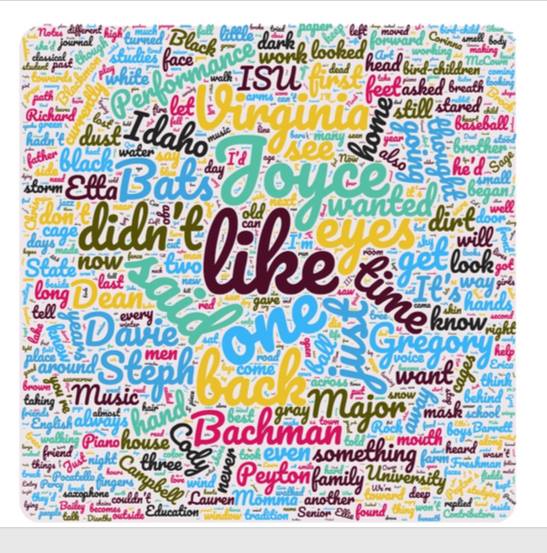
This is a wordcloud created from last year’s issue! We look forward to seeing what words trend in our 2018 issue.  🤩
🤩
🤩
 🤩
🤩Editor-in-Chief Anelise Farris had the opportunity to chat with our upcoming visiting writer Matthew James Babcock. An instructor at BYU Idaho and an accomplished writer, Babcock will be at Idaho State University from February 7-9, 2018. Please see our calendar for an event schedule. Meanwhile, check out the Q&A below!
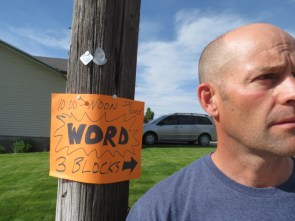
I’m not sure I want writing ever to become more than a hobby. I think the moment I start thinking about writing as something that others have invited me into a certain professional class to perform, I’ll probably be sunk as an artist. My favorite pieces are those I wrote largely because I wandered into some subconscious stream and thought of publishing only as an afterthought. Rather than in some ordained or professional class, I think writers belong in the ranks of public servants, the civil servants of language, the slingers of soup kitchen metaphor, the volunteer fire departments of tragedy, longing, and amazement. I wrote a book on a minor American poet named Robert Francis—mostly because a study on his life and oeuvre was long overdue—and he gave himself the title “Wordman.” I’d rather see the world populated with wordwomen, wordkids, and wordmen before I see it glinting and gaudy from another round of coronations, especially among writers. It can be slippery trying to stand your whole life on the ivory tower.
I think influence is mostly subconscious, so it’s hard to say. And it’s hard to answer this question without flattering yourself. Styles I’ve admired and still admire: Whitman, Dickinson, Wallace Stevens, Faulkner, George Eliot, Virginia Woolf, and more contemporaneously, Tim O’Brien, Peter Davis, Amy Newman, Tony Hoagland, Brian Doyle, Anthony Doerr, and most recently Meghan O’Gieblyn. All these people have astonished me, and I think rather than say they’ve influenced my style—which even as I write it sounds humongously arrogant. I’d have to say they’ve absolutely amazed me and shown me what language can do if you get out of the way and let it fly.
In between. On the fly. In transit. I’ve never had the luxury of any kind of garret or coastal lighthouse or bunker. I don’t come from a family of writers, and so I’ve had to learn to take my writing with me and finish things flopped on the living room floor after a board game, or sprawled on the couch after a diaper changing or dissertation chapter. The year my wife and I got married (young, in college), she still had a year to graduate, and so I had this one long delicious year during which I worked about four jobs but basically dropped by the public library, walked around town, and tapped away on my Gateway 2000 computer. And then when we had three kids, she went to New York with all three to visit her family, and I was left with just the dog and three weeks, and I think during that time I wrote an entire fiction manuscript because I had the time. But apart from those two brief periods, I’ve been scratching out word after word, line after line, mostly with paper and pad that I carry with me to middle school choir concerts and basketball games and piano recitals. Sounds tragic, I know, but I’ve found those mundane settings capable of setting of some inner fireworks when you aren’t expecting it. So always have your writing materials with you.
Well, you never succeed and you never fail. You never get bored, and there’s always somewhere else to go and something new to try. Writing is your endless smorgasbord. I work in multiple genres mostly because I teach multiple genres, and I teach multiple genres because I’ve never felt completely at home in just one. I was talking to one of my colleagues recently about his fiction writing, and he in turn asked about my writing projects, and when I couldn’t really tell him what I was working on, he said, “You’re a dabbler.” At first, I bristled at this label, but immediately afterward, I thought, “Hey, I like that.” Kind of like Yankee Doodle. It was meant as a slur, but it became a badge of honor. I wear the dabbler bandolier with a bit of a swagger nowadays.
Always. But some of my best writing moments have come from teaching. First off, in my first creative class, twenty years ago, one student raised his hand and asked, “What have you written and published?” Fresh out of grad school, I had little to say, although I had published a smattering of droll drivel in obscure journals. But that sent me back to my office, and I started writing every day on my lunch hour, which has produced four published books (criticism, poetry, and nonfiction) with two books of fiction to follow and maybe a few stragglers in my twilight years if my eyesight holds out. One student who failed freshman English three times but then passed it on his fourth try with me wrote a narrative that used such an inventive structure I stole it and modified it to write a longer piece of fiction, “Impressions,” which is in one of my upcoming collections. During a routine discussion on narrative tense and perspective in another composition class, a student raised his hand and said, “Who’d want to write a story in future perfect tense?” (Future perfect is actually a mood, technically, and not a tense, one of my grammarian friends reminds me). But I went back to my office and started writing “Future Perfect,” a mini-novella about four generations of an Idaho family, and their different paths toward finding a better tomorrow. This also became the title story in a second fiction collection that will soon be released. Here’s Wally Stegner: “To conform to the mores of the pedagogical profession, grind over comma faults and agreement errors and faulty parallelism during working hours, and yet keep close and inviolate a certain artistic integrity which labors to learn the craft of writing. . . . [N]o matter how hard the apprenticeship in pedagogy for the average man, it can be withstood, and it cannot ruin him as an artist.” I’m not sure I’m withstanding teaching the way Stegner puts it here, but I have found that if you don’t try to keep them separate endeavors, writing and teaching do feed off one another. Time, of course, is the issue. There’s never enough while you’re doing both. But I’ve also found that if I share what I’m writing with my students, it infuses our efforts into a kind of camaraderie, and that keeps me going in both fields.
Mostly Swift for a major author’s course. I want to try to understand satire because I think there’s an undercurrent of satire in some subterranean cavern in me, and I’ve yet to tap it. But also The Pushcart Prizes. The Pushcart Prize anthology is always my big Christmas present to myself. I just finished the last Best American Essays (and the two best, ta-dah!, awarded by me, are Greg Marshall’s “If I Only Had a Leg” and Meghan O’Gieblyn’s “Dispatch from Flyover Country.”) George Singleton’s comic Southern fiction has left me dancing in circles, particularly his story “Staff Picks.” But nobody is going to beat Anthony Doerr in my lifetime.
Orwell. Defoe. Jane Austen. Whoever compiled the New Testament. And Robert Francis, the subject of my book, a writer I feel like I know but was never able to meet. I was lucky enough to sup on Sushi with Brian Doyle before he died. One of the most spiritual experiences I’ve had is listening to Doyle read “Leap” from a student’s cell phone while he walked around and around one of our campus chapels. When I met Tim O’Brien and Anthony Doerr, I just started babbling like a teenage crush. It’s hard for me to be around writers I really admire, probably because I’m constantly robed in the fog of my own inadequacies.
I have taught myself to ride a unicycle, juggle, and breakdance. But I can’t repair cars, and most household appliances are safe in my presence.
Read then write.
It’s going to take your whole life, but what better way to go?
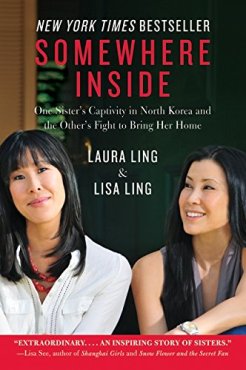 Over break, I read Somewhere Inside by journalists Laura Ling and Lisa Ling. It is an autobiography written by sisters, telling of how Laura was arrested in North Korea and Lisa worked tirelessly to bring her home using all her media and political contacts. The story is told in alternating perspectives, which makes the storytelling really interesting.
The story itself was an interesting read given the current political tensions between the United States and North Korea. And it was fascinating to hear an American’s perspective on the inner workings of North Korea that we never hear about. I would recommend this book to anyone even remotely interested in North Korea, international relations, journalism, or just a really great book that explores the importance of connections and relationships.
Anelise Farris had the opportunity to chat with Katie Damron, the new poetry editor for Black Rock & Sage. Katie reveals what her biggest fear is, how she spends her free-time, and who she’d like to invite to a dinner party. She also offers some great advice for aspiring artists and art enthusiasts. Check out the Q&A below!

—
Imaginative, open-minded, and sophisticated.
My iPhone! I know that sounds very millennial and material, but I use my phone for instant communication with friends and family, and I couldn’t live without having that.
Outer space! It’s vast and volatile and extremely unknown to us. And once you’re up there, it’s hard to come home. Movies about space give me anxiety!
I don’t know if I have a favorite place to be, but I definitely have favorite people to be places with.
I love to write and cook…and I love being with my friends and family.
I recently went to San Francisco for the first time, and it was so great! I loved the city and the people I met there. It’s unlike any other place I’ve been.
I would love to do creative work for a magazine. Being a creative director with writing responsibilities at a fashion or lifestyle magazine would be my dream job.
My favorite book and movie is The Godfather. (Seriously, if you haven’t read The Godfather, you are missing out on the best book!) And my favorite band is Bleachers.
I love hockey! I don’t like to play, but I love watching the sport. My favorite team is the Philadelphia Flyers.
“Life is a flower here, a flower there, but rarely a bouquet.” (Not sure who said this…)
Ashley Ford is this super cool writer based out of NYC, but she’s from the Midwest. She has the most interesting perspectives on race, travel, mental health, social media, relationships, creative processes, money, etc. I’d love to meet her.
Shonda Rhimes. That woman is a creative genius and I want to know everything about her creative process.
Nina Garcia was the creative director at Marie Claire magazine for a long time, and I fell in love with her aesthetic and voice in her writing. Now she has taken the job as editor-in-chief at Elle, and I can’t wait to see what she does there.
I love BBQ food, so if I had to eat BBQ for the rest of my life, I wouldn’t complain.
13. If Hollywood made a movie about your life, who would you like to see cast as you?
Kate Mara! We don’t look anything alike, but I love her acting style and she’s a very elegant woman.
Probably an alligator. They live in warm tropical places and are very fierce.
15. If you were stuck on an island, what three things would you bring?
My best friend! Matches. And a boat to get home when I’m ready to leave.
I would choose invisibility. I’d use the power to avoid waiting. For instance, if I were invisible, I could walk to the front of the line at Disneyland.
I love to cook; I watch an embarrassing amount of makeup tutorials; and, more recently, I’ve been doing some outdoorsy things and learning to love them.
I’d like to move out of Pocatello and experience a different area. Hopefully I have a job I love! And hopefully I still have time to write.
Subtropics is a pretty cool lit mag I picked up last semester and have enjoyed.
Be patient with yourself! Everyone is constantly learning and evolving, even the experts.

Black Rock & Sage had the opportunity to chat with writer Christian Winn, who will be visiting ISU on Thursday, September 21. His reading and signing will be held in the Bengal Cafe at 5:30pm. Please join us!
—
I guess, in many ways, I never have considered creative writing a hobby, but something that has always been more akin to a part of both my innate personality and my deep belief in self expression. I’ve always really believed in the poems/stories/novels/essays I’ve written. Not to say that these pieces have always been good, or even close to good, but they have always felt essential and important to me. So, I guess the word hobby, doesn’t quite fit how I ever have thought about my writing.
Oh man, this is a tough question, because there have been so many wonderful writers who have influenced my own creative process, both stylistically and in its essence and understanding of the art and craft of writing fiction. I’ll name ten here, but I could probably roll out fifty, or more, who have had an influence in a couple of ways.
Here goes, in no particular order.
I’d have to say, the issue of theme for me doesn’t really come up as I’m writing, or thinking of how to write, or drafting out the stories themselves. I mostly just try to write stories about people, and situations that matter deep down to those people, and to me, and hopefully to the reader. The themes seem to emerge as the stories get written, and then assembled into books. I ultimately feel that figuring out themes are more the job of the reader than the writer. It’s often so tough to know what you’re writing about, until you have written it, and still maybe not even then.
As a writer I really only feel comfortable writing stories set in places I know well, and having lived only in the West – Oregon, California, Washington, and Idaho – I like to set my stories in those places. As well, I feel I deeply know the people and landscape of the West – whether in the cities, small towns, open lands, mountains, deserts – in ways that allow me to really (hopefully) understand my characters, and the troubles and triumphs they experience in this Western part of our country.
At times it can be a bit difficult to balance time with students, and student writing, simply because sometimes my own creative energy, and writing time, gets eaten up by time spent in the classroom, or figuring out new and interesting ways to teach writing. However, far more often than not the experience of presenting and analyzing published work to young writers, and critiquing my students’ work in progress, is inspiring, enriching, and helps me understand my own process and overall knowledge of craft as a writer.
I am actually rereading, and teaching, A Visit From The Goon Squad, by Jennifer Egan, one of my favorite novels, ever, this semester. Also, Emily Ruskovich’s novel, Idaho. Amazing! As well, I always try to keep up on the newest New Yorker short stories – Lauren Groff, Etgar Keret, Miranda July have had some awesome pieces in there these last couple of months. George Saunders’ Lincoln in the Bardo is next on my list of novels to read, I think, there are so many books on my shelves starting at me each day, saying, “Read me!”
It may sound a tad cliché, but I think I’d like to have a drink, or several, with Charles Bukowski down at my favorite bar in Boise – the 10th Street Station – just to see if Bukowski was as much of a lout, an asshole, a poet, a drunk, a charming rambling wonder, as the mythology speaks to. The hangover would be fierce, but worth it, I think.
I was a very serious break dancer in the early/mid 1980’s. We had a crew and everything. I could head spin! Also, around that breakdancing time, I was a 1-handicap golfer, which is I suppose, an interesting juxtaposition. And, I once, many years ago, was issued a lewd conduct citation – it’s a good story, but I can’t tell it here.
It’s a (probably paraphrased) quote delivered by Gertrude Stein to Ernest Hemmingway after she read a number of early stories. She turned to him, and said as she handed the manuscript back to young Earnest, “Start over … And concentrate this time.”
See above. Also, keep looking at the world in new ways, and be both humble, and confident in your art.
 ISU's student Journal of Creative Works